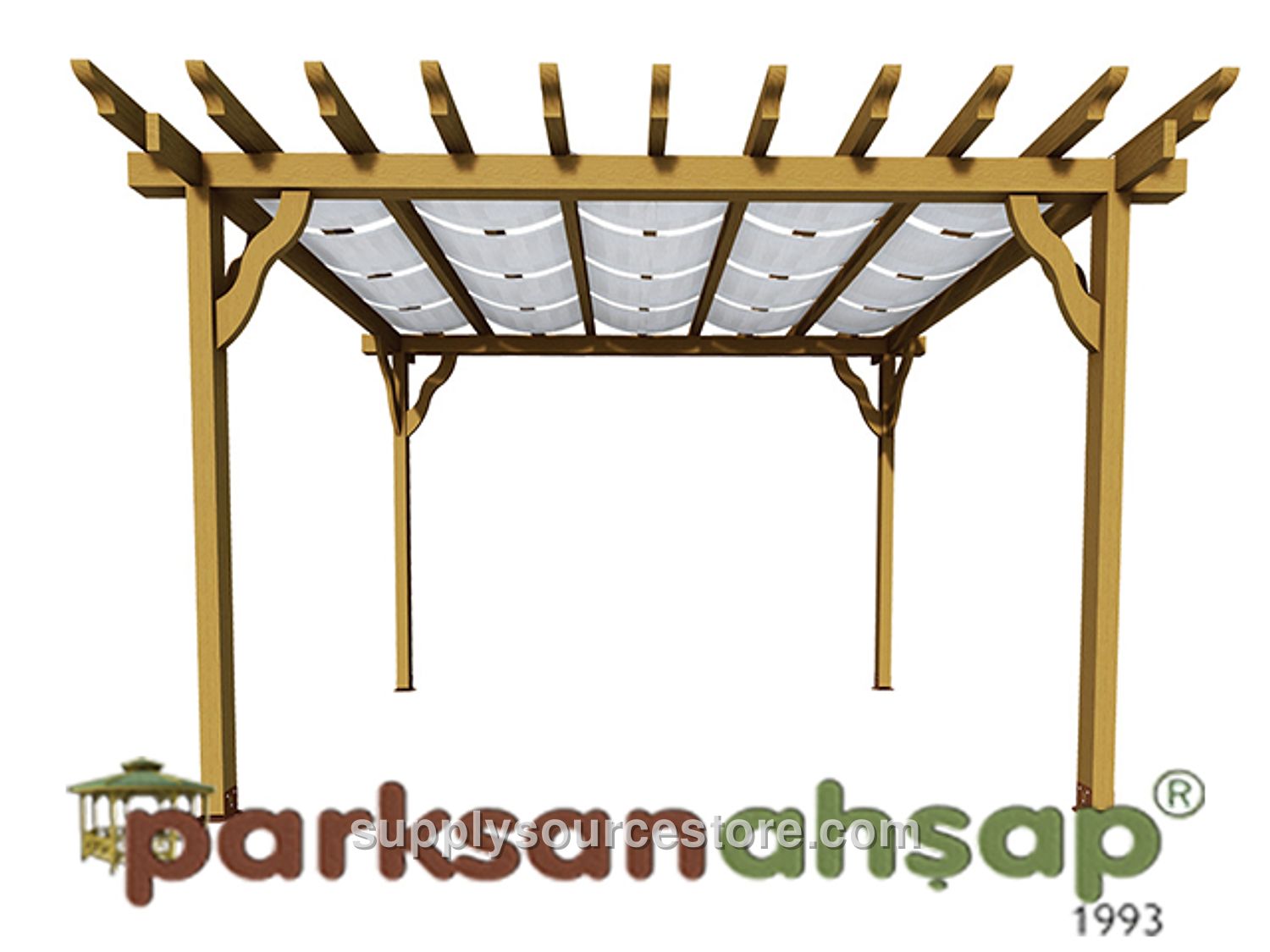
Wooden Braced Pergola 300(L)×500(W)×250(H)
Price on request
SKU: PS-70355
Seating Area: 300 x 500 cm (118 x 197 in) Roof Area: 390 x 560 cm (154 x 220 in) Height: 250 cm (98.4 in) Wood Characteristics: The wood material used for manufacturing will be first‑grade Yellow Pine (Pinus sylvestris) lumber. Wood sections will be cut with a maximum tolerance of ±2 mm (0.1 in), and wood dimensions with a maximum tolerance of ±20 mm (0.8 in). Required wood qualities include: knots – each meter may contain up to four sound knots; total knot diameters will not exceed one‑quarter of the piece width. No rot, decay, partially split or missing knots will be present. Cracks – no ring cracks; fine hairline cracks of 1–2 mm (0-0.1 in) may occur. Pressure‑treated wood may have permissible end‑ and length‑wise cracks within tolerance limits. Resin pockets – at most one pocket per meter, not exceeding 10 cm (3.9 in) in length. No inner bark, decay cavities, insect holes, or manufacturing defects; only deviations within the specified tolerances are allowed. Deflection – will not exceed 1/50 of the member length. Impact – will not exceed 1/100 of the member width. Twist – will not exceed 2 mm (0.1 in) per meter. Bending under load – tolerance between 1/50 and 1/100 of member length. Sanding – all visible surfaces will be sanded smooth. Primary Supports: Four support legs will be fabricated from 90 × 90 mm (3.5 x 3.5 in) pine lumber, each cut with diamond‑pointed special knives that imprint a motif. Because the pergola is sloped, one leg will be 220 cm (86.6 in) high and the opposite leg 240 cm (94.5 in) high. Roof: The roof’s bearing beams will be made from 50 × 100 mm (2 x 3.9 in) timber. Two corners of each beam will be routed to shape them. Motif‑cut 50 × 100 mm (2 x 3.9 in) decorative brackets will be installed on the bearing beams. All fixed connections will use special galvanized wood screws. Anchoring: A 150 × 150 × 5 mm (5.9 x 5.9 x 0.2 in) flange with a 90 × 70 × 5 mm (3.5 x 2.8 x 0.2 in) welded plate will be attached beneath each support leg, with a 12 mm (0.5 in) diameter hole drilled. Anchors will be bolted to the legs and connected to the ground with steel dowels, preventing water contact with the wood and ensuring stable footings. Picnic gazebo anchors will be welded to a minimum of two sides of each 3 mm (0.1 in) thick flange. Six special screws will be placed on each leg for the anchor‑to‑post connection, and two dowel screws per leg for the ground connection. All metal components will be powder‑coated with a polyester‑based paint and cured in a furnace.