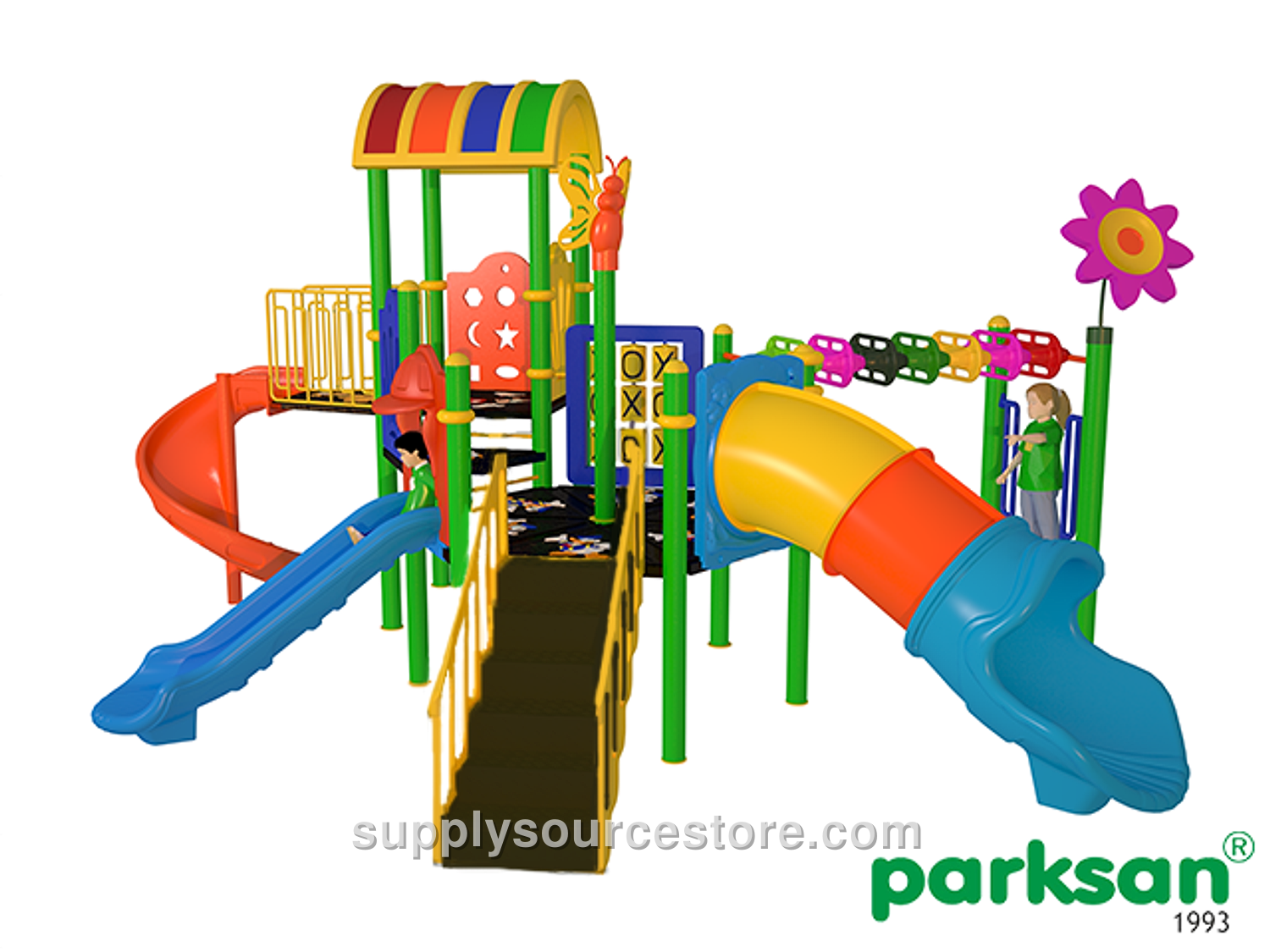
Rainbow Series Playground
Price on request
SKU: S27-PS-0050507
PRODUCT SPARE PARTS • 116x116 composite triangular platform – 7 pcs • 116x116 composite square platform – 1 pc • Metal spiral slide extension – 1 pc • Metal spiral slide extension handrail – 1 pc • Composite intermediate stair – 2 pcs • H:150 cm (59.1 in) spiral slide – 1 pc • H:100 cm (39.4 in) tube slide – 1 pc • H:100 cm (39.4 in) straight slide – 1 pc • Composite stair – 1 pc • Metal stair handrail – 1 pc • Metal pull‑up bar pipe – 2 pcs • Polyethylene raised support element – 6 pcs • Polyethylene flower figure – 1 pc • Polyethylene slide entrance – 2 pcs • Polyethylene plaza barrier – 5 pcs • Polyethylene butterfly figure – 1 pc • H:100 cm (39.4 in) open tower pipe – 9 pcs • H:150 cm (59.1 in) closed tower pipe – 4 pcs • Rainbow roof – 1 pc Polyethylene Products Low‑density linear polyethylene (LLDPE) is a thermoplastic used in various products. It is a semi‑permeable, pliable, and highly durable polymer that is favored in industry for its low cost and high resistance. Based on density and chemical properties, polyethylene is classified into several categories. Its mechanical properties depend on molecular weight, crystalline structure, and branching type. While properties vary, it generally offers good resistance to outdoor conditions and moisture, flexibility, low mechanical strength, and excellent chemical resistance. Polyethylene components are used in the manufacture of slides, stairs, handrails, barriers, accessories, roofs, etc. To prevent color fading, masterbatch pigments used for coloring polyethylene must have a light fastness rating of 6 or higher. The wall thickness of products must be at least 6 mm (0.2 in) where they are subjected to pressure and friction, and at least 4 mm (0.2 in) for components not exposed to pressure, such as barriers and shade structures. Material distribution must be uniform, and the thickness tolerance is ±5 %. Carrier Construction The carrier construction consists of cold‑formed steel tubes with a minimum diameter of 114 mm (4.5 in) and a wall thickness of at least 2 mm (0.1 in), conforming to TS EN 10219‑2, TS‑6476, DIN 2394 standards. Tubes are welded by high‑frequency welding and painted using an electrostatic powder coating applied over a sandblasted surface. Electrostatic Powder Coating All metal parts are sandblasted to remove oil, dirt, and rust, creating a profile for better paint adhesion. A fine‑ball coating material is sprayed with compressed air to open pores for paint adherence and to clean the metal surface. After coating with a polyester‑based electrostatic powder, parts are cured in a 200‑220 °C oven for 20 minutes. Following manufacture, metal components undergo a 10‑minute, 70 °C, 5 % solvent‑degreasing bath, then a 15‑minute, 50 °C, 1 % iron bath, followed by rinsing and drying. Finally, the entire assembly is powder‑coated and cured at 180‑200 °C for 20‑30 minutes. Welds are fully painted after welding to prevent corrosion.