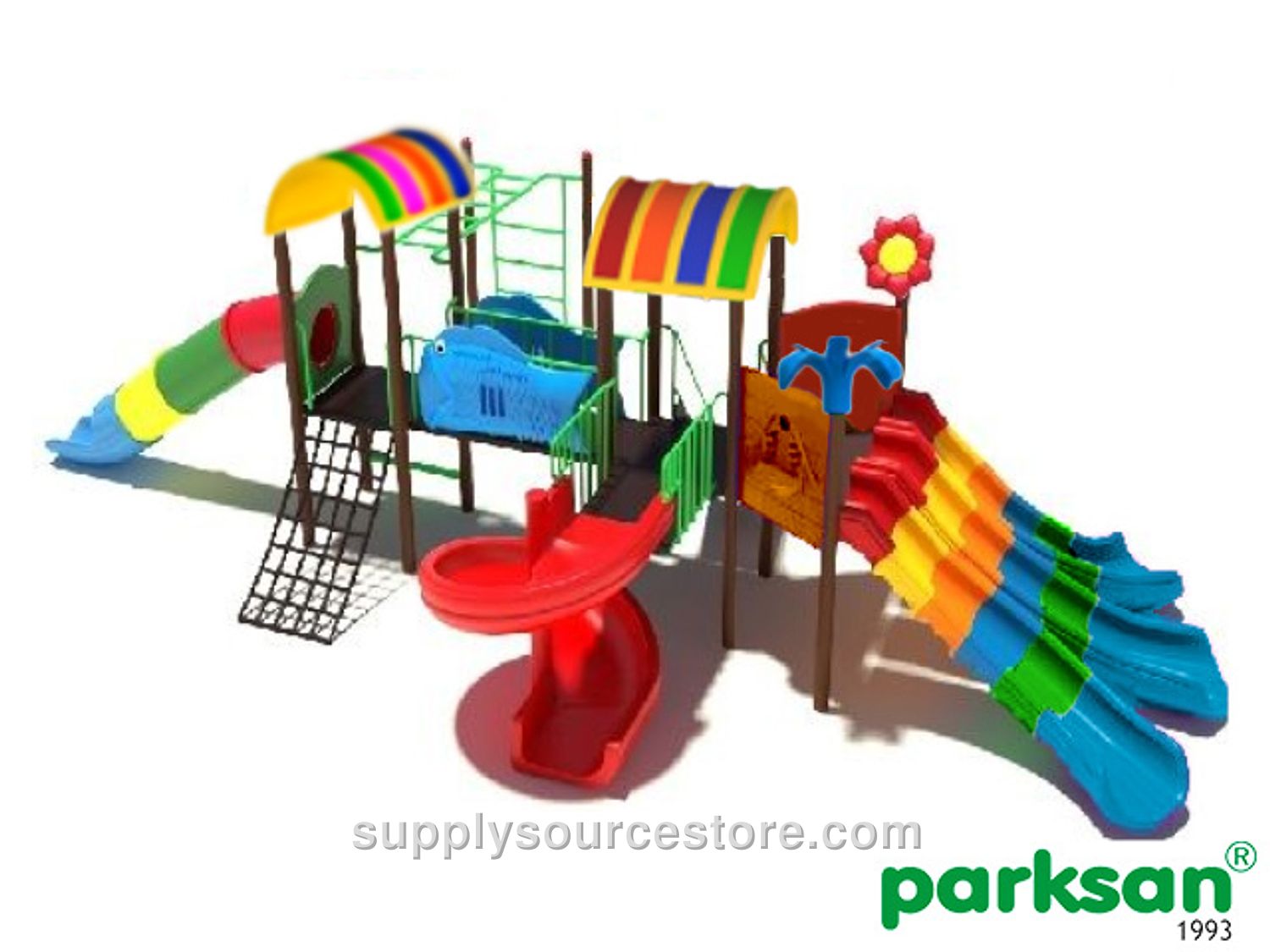
Rainbow Series Playground
Price on request
SKU: S27-PS-0050512
Spare Parts - 150 cm (59.1 in) metal guardrail – 1 piece - Composite ladder – 1 piece - 116 x 116 cm (45.7 x 45.7 in) composite square platform – 3 pieces - 116 x 116 cm (45.7 x 45.7 in) composite triangular platform – 2 pieces - Metal bridge extension – 1 piece - Polyethylene fish passage – 1 piece - 150 cm (59.1 in) rope climbing element – 1 piece - 150 cm (59.1 in) tube slide – 1 piece - 150 cm (59.1 in) triple slide – 1 piece - Pull‑up bar climbing element – 1 piece - Spiral slide extension – 1 piece - 150 cm (59.1 in) spiral slide – 1 piece - Rainbow roof – 1 piece - Polyethylene play area barriers – 2 pieces - Polyethylene slide entrance – 1 piece - Polyethylene flower figure – 1 piece - Polyethylene palm figure – 1 piece - 150 cm (59.1 in) tower pipe – 10 pieces Polyethylene Products Low‑density linear polyethylene (LLDPE) is a thermoplastic used in various applications. It is a semi‑permeable, softening, highly durable polymer that is favored in industry for its low cost and high resistance. Based on density and chemical properties, polyethylene is classified into several categories. Its mechanical properties depend on molecular weight, crystal structure, and branching type. While specific properties vary, it generally offers good resistance to outdoor conditions and moisture, flexibility, low mechanical strength, and excellent chemical resistance. Polyethylene is used to manufacture slides, ladders, guardrails, barriers, accessories, roofs, and more. To prevent color fading, masterbatch pigments used for coloring polyethylene must have a lightfastness value of 6 or higher. The material thickness should be at least 6 mm (0.2 in) for components exposed to pressure or friction, and at least 4 mm (0.2 in) for non‑load‑bearing barriers and shade structures. Material distribution must be uniform to achieve consistent thickness. Product thicknesses and dimensional tolerances are ±5%. Electrostatic Powder Coating Process All metal components are sandblasted to remove oil, dirt, and rust, creating a porous surface for better paint adhesion. Fine steel beads are then propelled with compressed air to further open pores and eliminate contaminants. After manufacturing, metal parts are coated with a polyester‑based electrostatic powder and cured in a 200‑220 °C oven for 20 minutes. Subsequently, the parts undergo a 10‑minute dip in a 70 °C, 5 % concentration oil removal bath, followed by a 15‑minute immersion in a 50 °C, 1 % concentration iron bath. After rinsing and drying, the components receive a final polyester‑based powder coating applied outdoors, then cured in a 180‑200 °C oven for 20‑30 minutes. All welds are fully painted after welding to prevent corrosion.