Economic Series Playground · SS-012545
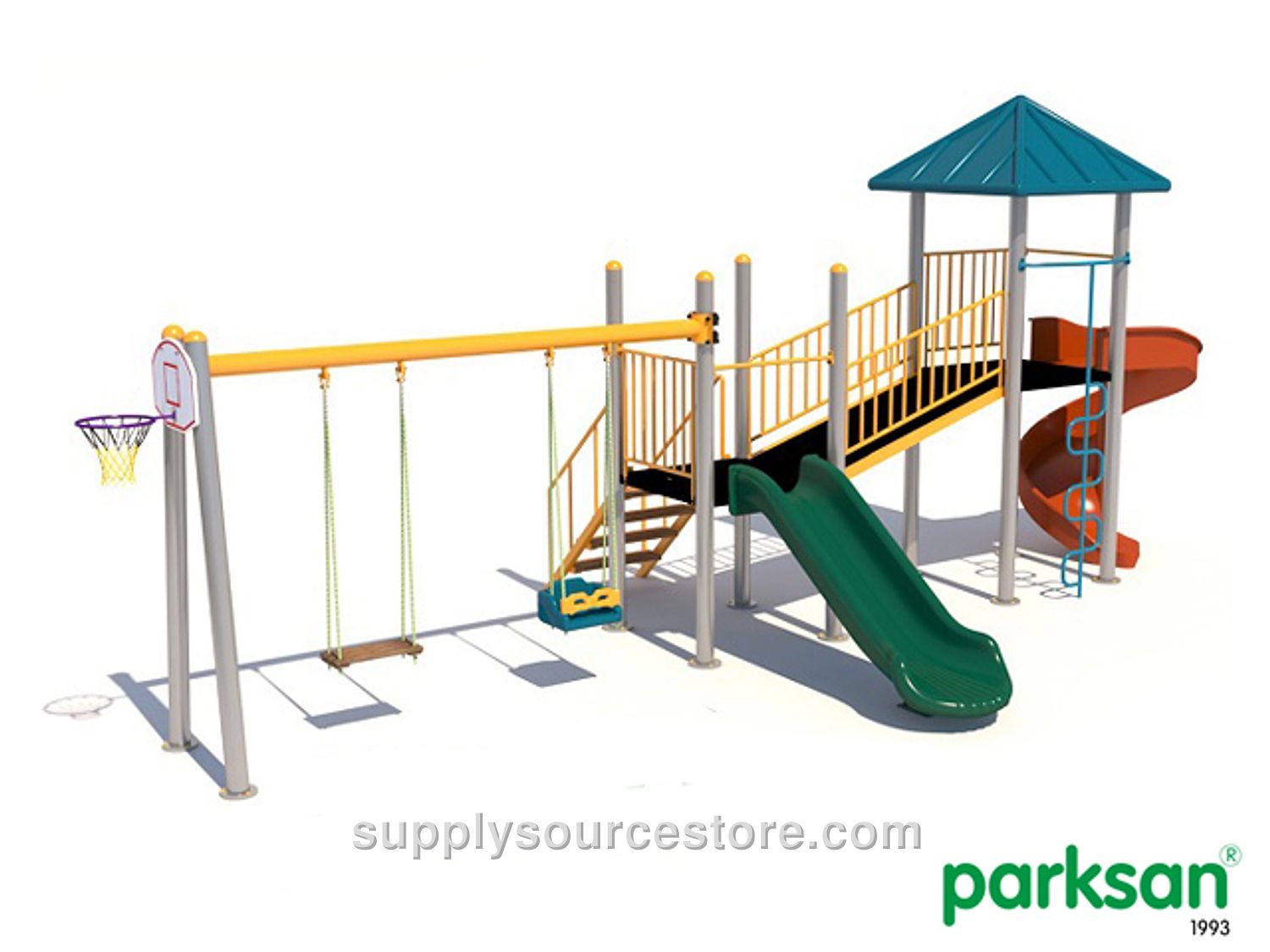
Price on request
SKU: SS-012545
Technical Specifications Seating Area: 430 × 810 cm (169 x 319 in) Safety Area: 730 × 1110 cm (287 x 437 in) Slide Attachment Height: 100 cm (39.4 in) – 150 cm (59.1 in) User Capacity: 3 User Age Group: 3 years and up Carrier Structure The carrier structure is made of cold‑formed steel tubes with a minimum diameter of 89 mm (3.5 in) and a wall thickness of 2.5 mm (0.1 in), conforming to TS EN 10219‑2, TS‑6476, DIN 2394 standards. Tubes are welded using high‑frequency welding and then painted in a polyester‑based electrostatic powder‑coat. Upper ends of the tubes are sealed with polyethylene caps fastened by at least two aluminum rivets shaped as half‑spheres to prevent water, moisture, and foreign material ingress. Both vertical and horizontal tubes (minimum 89 mm (3.5 in) diameter) are joined at right angles with polymer‑based connectors produced by aluminum casting or injection molding. The lower ends of the carrier tubes are welded to steel plate flanges of at least 150 × 150 × 5 mm (5.9 x 5.9 x 0.2 in). For installations on hard ground, the tubes are anchored with steel expansion bolts (minimum 8 × 75 mm (0.3 x 3 in)) through 10 mm (0.4 in) holes in the flanges. For soil installations, an anchor system consisting of four galvanized M10 × 40 mm (0.4 x 1.6 in) screws welded to 150 × 150 × 5 mm (5.9 x 5.9 x 0.2 in) plate flanges is used on a pipe of at least 89 mm (3.5 in) diameter, 2.5 mm (0.1 in) wall thickness, and 200 mm (7.9 in) length. The carrier tubes are supplied as single pieces, with no additional pipe sections, weld seams, or stitch marks. Platforms, railings, or brackets are not welded directly to the carrier tubes; however, plate or plastic‑coated platforms can be welded with flanges of at least 5 mm (0.2 in) wall thickness, matching the platform’s corner geometry and drill pattern. CTP (CAM FIBER‑REINFORCED POLYESTER) COMPONENTS CTP stands for "Cam Elyaf Takviyeli Polyester" (glass‑fiber‑reinforced polyester). CTP is used for slides, stairs, railings, barriers, accessories, roofs, etc. The material combines unsaturated polyester resin with glass‑fiber reinforcement, offering higher mechanical strength than pure polyester. It is resistant to climate changes, temperature variations, chlorinated water, and a wide range of chemicals, and it does not become electrically conductive. The production process involves weaving fine glass fibers into a thin, flexible fabric, impregnating the fabric with polyester resin and catalyst, and then curing it through multiple layers. The resulting composite is strong, lightweight, and can be sanded and painted for a smooth finish. A performance gelcoat pigment, containing isophthalamide/NPG‑based acrylic modifiers and a high‑temperature resistant acrylic accelerator, is applied in two coats (0.80 µm each) on a 5 mm (0.2 in) thick fiber layer. The coating provides excellent resistance to heat up to 215 °C, UV‑induced yellowing, fading, and chalking. The final film has a weight of 450 g/m² for the two‑coat layer and 600 g/m² for the single‑coat layer, processed with CE 92 N8 polyester resin for high mechanical durability. No post‑coloring is performed. Polyethylene Components Low‑density linear polyethylene (LLDPE) is a thermoplastic used in various components such as slides, stairs, railings, barriers, accessories, and roofs. It is semi‑permeable, flexible, and cost‑effective while offering high chemical resistance. Polyethylene grades are selected based on density and chemical properties. All polyethylene products used in playground equipment meet the required thickness standards: a minimum of 6 mm (0.2 in) for parts subjected to pressure or friction, and a minimum of 4 mm (0.2 in) for barriers and shade structures not exposed to load. Thickness tolerance is ±5%. Electrostatic Powder‑Coat Paint All metal parts are first blasted to remove oil, dirt, and rust, creating a porous surface that enhances paint adhesion. A fine metal powder is then sprayed with pressurized air into the pores, forming a durable, corrosion‑resistant coating.