Economic Series Playground
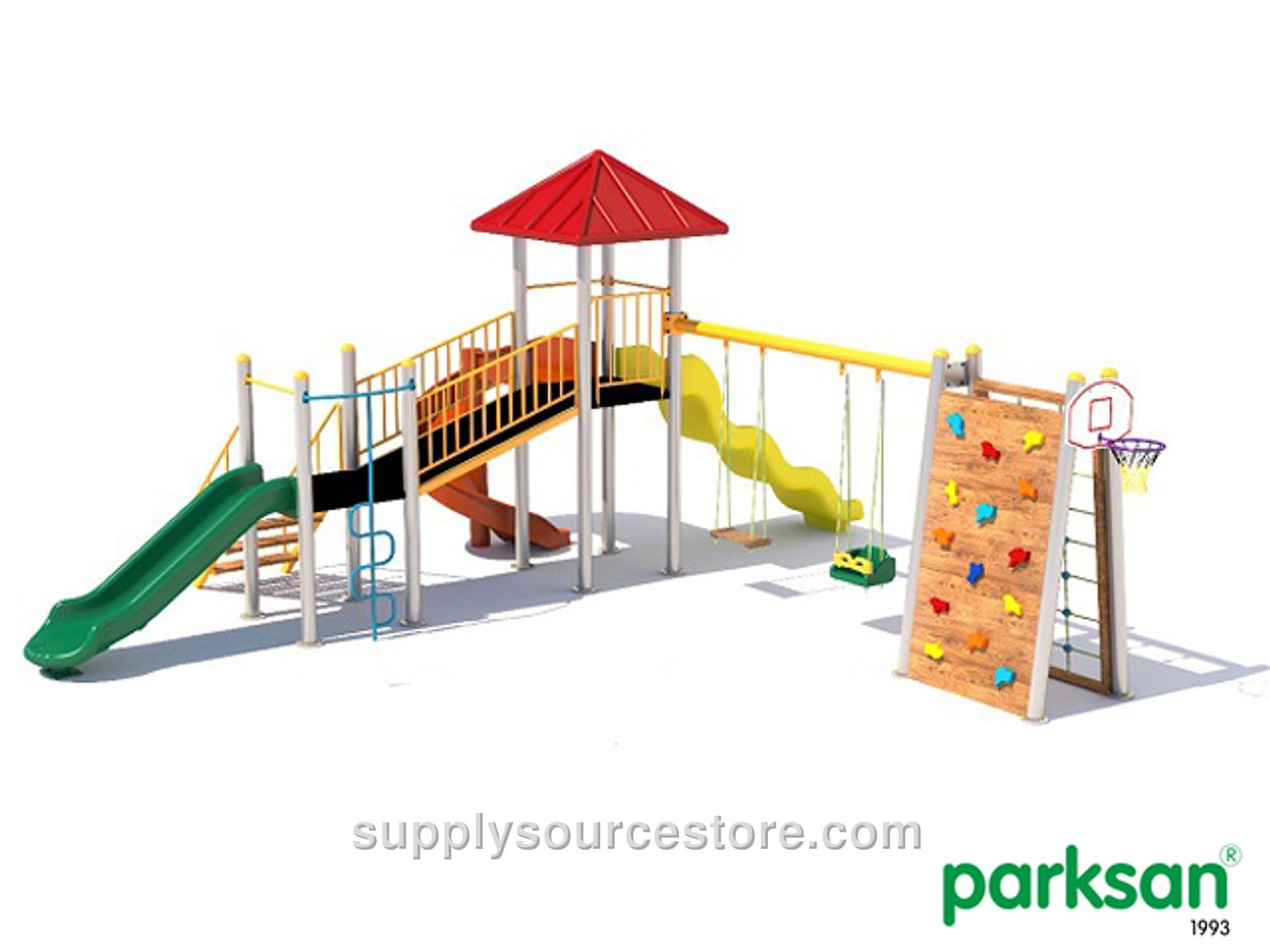
Price on request
SKU: PS-50813
Product Technical Specifications\nSeating Area: 730 x 760 cm (287 x 299 in)\nSafety Area: 1030 x 1060 cm (406 x 417 in)\nSlide Connection Height: 150 cm (59.1 in)\nUser Capacity: 3\nUser Age Group: 3+ years\n\nCarrier Construction\nThe carrier structure is fabricated from cold‑formed steel tubes with a minimum outer diameter of 89 mm (3.5 in) and a wall thickness of at least 2.5 mm (0.1 in), conforming to TS EN 10219‑2, TS‑6476, DIN 2394 standards. Tubes are welded by high‑frequency welding and produced within standard tolerances for dimensions and cross‑section. The tubes are coated by sandblasting and then painted with a polyester‑based electrostatic powder‑coat applied in a furnace.\nThe upper ends of these tubes are sealed with polyethylene caps fastened by at least two aluminum rivets shaped as half‑spheres to prevent ingress of water, moisture, and foreign material.\nVertical and horizontal sand‑blasted tubes (minimum 89 mm (3.5 in) diameter) are joined at right angles using aluminum‑cast or injection‑molded polyamide connection elements.\nThe lower ends of the carrier tubes are welded to steel plate flanges sized at least 150 × 150 × 5 mm (5.9 x 5.9 x 0.2 in). For installation on a hard ground surface, the tubes are anchored to the ground with steel expansion bolts (minimum 8 × 75 mm (0.3 x 3 in)) inserted through 10 mm (0.4 in) holes in the plate flanges. For soil installation, an anchorage system comprising four galvanized M10 × 40 mm (0.4 x 1.6 in) screws welded to a 150 × 150 × 5 mm (5.9 x 5.9 x 0.2 in) plate flange is used on a sand‑blasted tube of at least 89 mm (3.5 in) diameter and 2.5 mm (0.1 in) wall thickness, extending at least 200 mm (7.9 in) above ground.\nThe carrier tubes are supplied as one continuous piece; no additional pipe sections, weld beads, or seams are permitted.\nPlatforms, guardrails, or clamps are not welded directly to the carrier tubes. However, when mounting plastic‑coated or steel platforms, flanges of at least 5 mm (0.2 in) wall thickness may be welded to match the platform’s corner geometry and bolt holes.\n\nCTP (Glass‑Fiber‑Reinforced Polyester) Products\nCTP stands for "Cam Elyaf Takviyeli Polyester" (Glass‑Fiber‑Reinforced Polyester) and is used in the manufacture of slides, stairs, railings, barriers, accessories, roofs, etc. The material consists of unsaturated polyester reinforced with glass fibers, providing increased physical strength. CTP behaves like wood, concrete, metal, or glass but can be tailored to specific performance requirements, offering superior durability.\nIt is unaffected by climate conditions, resistant to temperature changes, chlorinated water, and all chemical agents, and does not become electrically charged, making it a modern composite material.\nGlass fibers are woven into a fine, flexible fabric that is placed in a mold, combined with polyester resin and a catalyst, then processed through multiple layers to produce a strong, lightweight composite. The final product can be sanded and painted.\nA performance gel coat pigment containing an isophthalic/NPG‑based acrylic modifier provides resistance to heat up to 215 °C, fatigue, cracking, yellowing, fading, and gloss loss. Two coats of 0.80 µm film thickness are applied, delivering a weight of 450 g/m² for the dual‑coat layer and 600 g/m² for the single‑coat layer, with a 5 mm (0.2 in) thick fiber layer made from CE‑92 N8 polyester for high mechanical resistance. No post‑coloring is applied.\n\nPolyethylene Products\nLow‑density linear polyethylene (LLDPE) is a thermoplastic used in various products. It is semi‑permeable, pliable, and highly durable, offering low cost and high resistance, making it popular in industry. Depending on density and chemical composition, polyethylene is classified into different categories. Its mechanical properties depend on molecular weight, crystalline structure, and branching. Generally, it exhibits good resistance to outdoor conditions and moisture, flexibility, low mechanical strength, and excellent chemical resistance. Polyethylene is employed for slides, stairs, railings, barriers, accessories, roofs, etc.\nTo prevent color fading, masterbatch pigments with a lightfastness rating of 6 or higher are used. Product wall thickness must be at least 6 mm (0.2 in) for components subjected to pressure and friction, and at least 4 mm (0.2 in) for barriers and shading elements not exposed to load. Thickness tolerances are ±5 %.\n\nElectrostatic Powder‑Coat Paint\nAll metal parts are first sandblasted to remove oil, dirt, and rust, creating a porous surface for better powder adhesion. A fine‑ball coating material is introduced into a pressurized cabin and sprayed with compressed air, opening pores and eliminating contaminants on the metal surface, preparing it for powder coating.