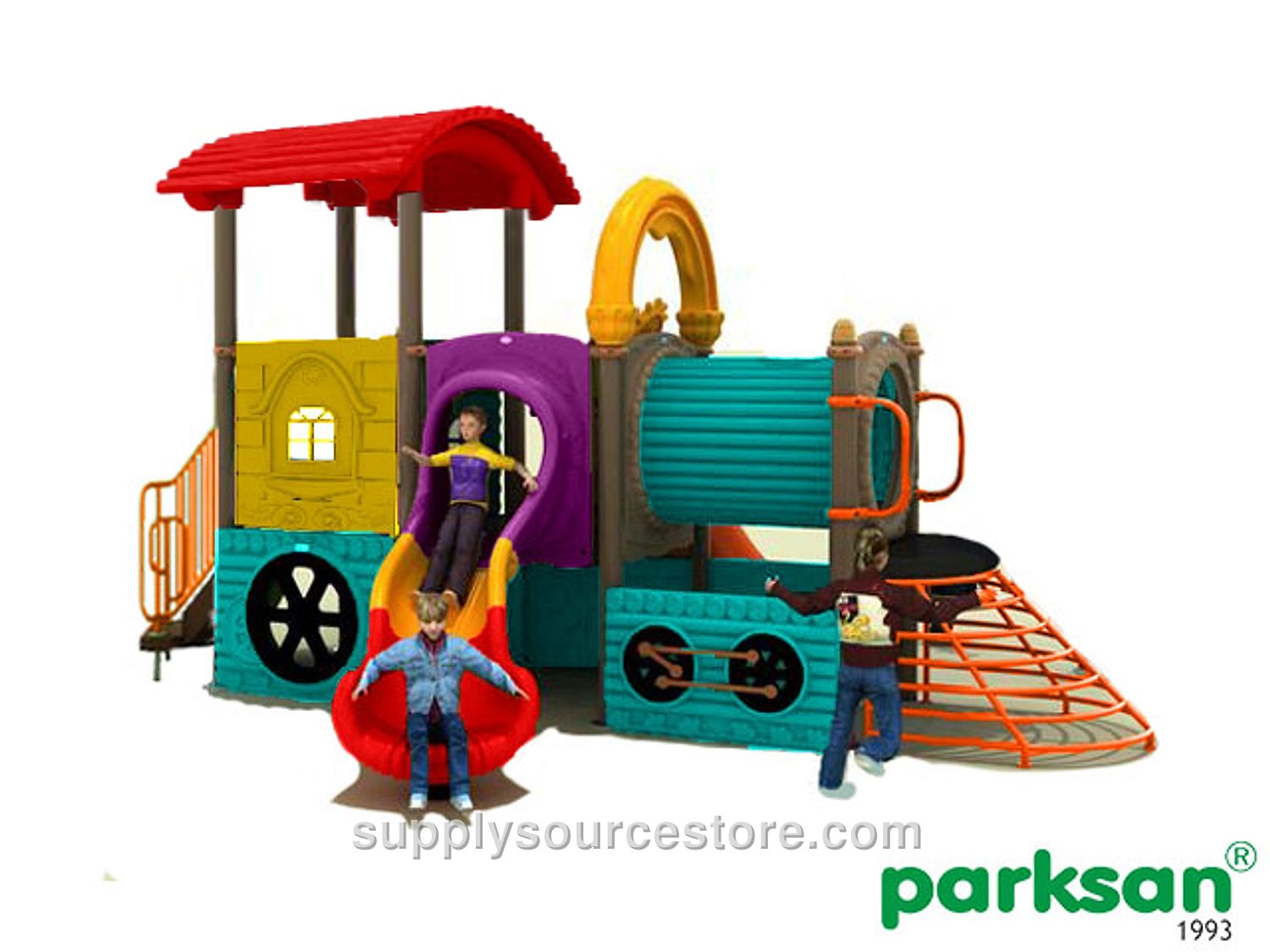
Children's Playground (Train Series) · SS-012438
Price on request
SKU: SS-012438
PRODUCT TECHNICAL SPECIFICATIONS Seating Area: 1085 x 411 cm (427 x 162 in) Safety Area: 711 x 1385 cm (280 x 545 in) Slide Connection Height: 100 cm (39.4 in) x 150 cm (59.1 in) SPARE PARTS - H:100 cm (39.4 in) Metal Climbing Element – 1 pc - Composite Stair – 1 pc - Metal Stair Railing – 1 pc - Polyethylene Tube Connector – 1 pc - Polyethylene Train Platform Barrier – 7 pcs - Polyethylene Train Roof – 1 pc - 116×116 mm (4.6 x 4.6 in) Square Composite Platform – 2 pcs - H:100 cm (39.4 in) Left‑Inclined Slide – 1 pc - H:100 cm (39.4 in) Straight Slide – 1 pc - H:100 cm (39.4 in) Roofed Tower Pipe – 4 pcs - H:100 cm (39.4 in) Tower Pipe – 4 pcs - Polyethylene Train Figure – 1 pc POLYETHYLENE PRODUCTS Low‑density (LLDPE – Linear Low Density Polyethylene) is a thermoplastic used in a variety of products. It is a semi‑permeable, softening, and highly durable polymer that is favored in industry for its low cost and high resistance. Polyethylene grades are classified based on density and chemical properties. Mechanical characteristics depend on molecular weight, crystalline structure, and branching type. Although properties vary by grade, they generally offer good resistance to outdoor conditions and moisture, flexibility, low mechanical strength, and excellent chemical resistance. Polyethylene components are used to manufacture slides, stairs, railings, barriers, accessories, roofs, and more. To prevent colour fading, the masterbatch pigments used for colouring polyethylene must have a lightfastness rating of 6 or higher. The wall thickness of load‑bearing parts must be at least 6 mm (0.2 in) where the material is subjected to pressure and friction, and a minimum of 4 mm (0.2 in) for non‑load‑bearing barrier or shading components. Material distribution should be uniform to achieve consistent thickness. Thickness tolerances are ±5%. CARRIER CONSTRUCTION The carrier structure will consist of cold‑formed steel tubes with a minimum diameter of 114 mm (4.5 in) and a minimum wall thickness of 2 mm (0.1 in), manufactured in accordance with TS EN 10219‑2, TS‑6476, DIN 2394 standards, welded by high‑frequency welding, and produced within the specified dimensional tolerances. The tubes will be sandblasted and then coated with a polyester‑based electrostatic powder paint. ELECTROSTATIC POWDER COATING All metal components will be sandblasted to remove oil, dirt, and rust, creating a porous surface that enhances paint adhesion. A fine‑ball medium will be sprayed with compressed air to open additional pores and clean the metal surface. After coating with polyester‑based electrostatic paint, the parts will be cured in a 200‑220 °C oven for 20 minutes. Subsequently, each metal part will undergo a 10‑minute, 70 °C, 5 % concentration oil‑removal bath, followed by a 15‑minute, 50 °C, 1 % concentration iron bath, rinse, and drying. Finally, the entire assembly will receive a uniform polyester‑based powder coating and be baked at 180‑200 °C for 20‑30 minutes. All welds will be fully covered with a seamless coating to prevent corrosion.