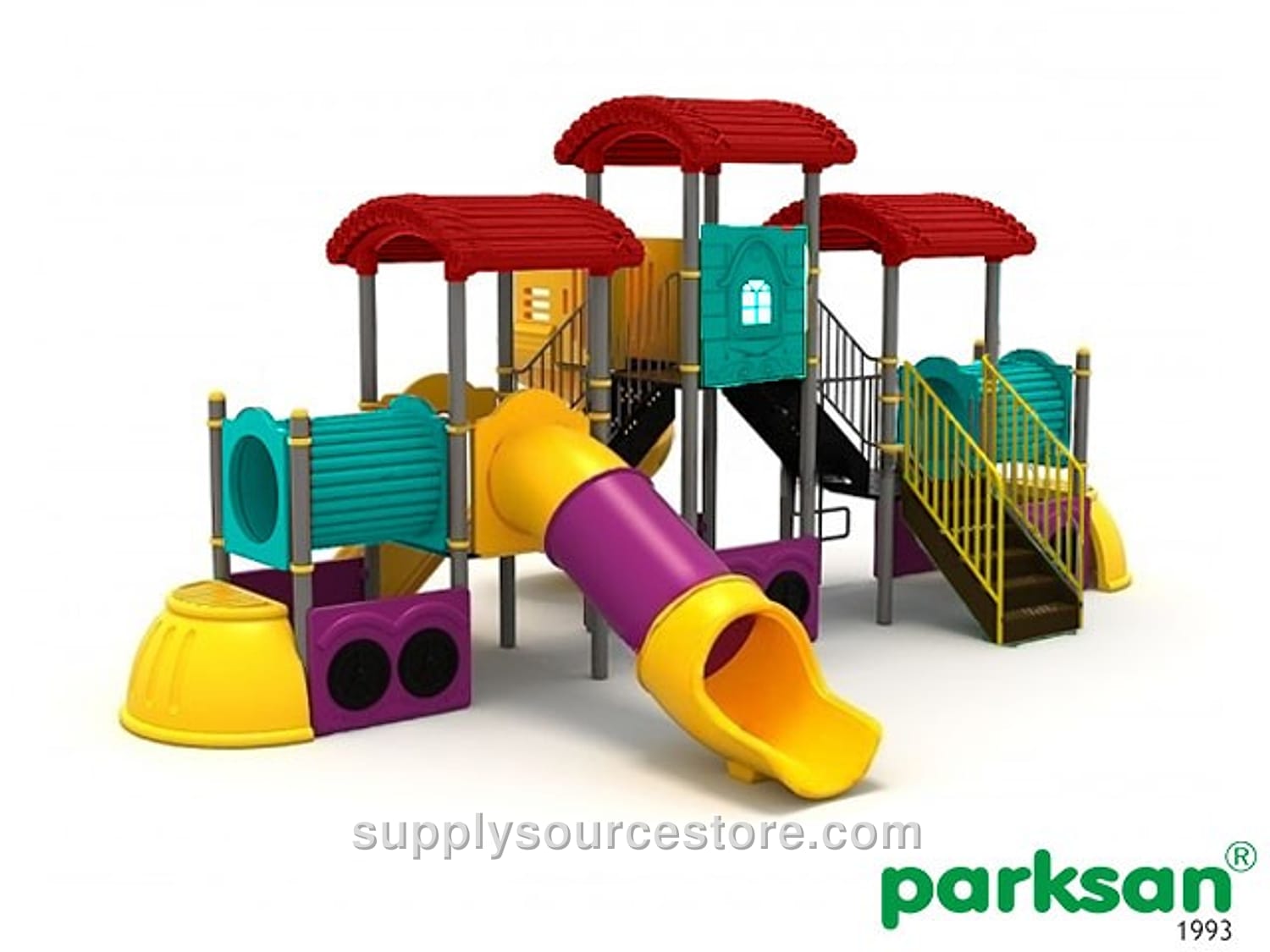
Train Playground
Price on request
SKU: SS-012429
Product Technical Specifications Age Range: 3+ years Capacity: 16–18 persons Height: 380 cm (150 in) Safety Area: 1215 × 905 cm (478 x 356 in) Spare Parts: - Polyethylene carriage – 2 pcs - Polyethylene train‑track barrier – 7 pcs - Polyethylene tube passage – 2 pcs - Polyethylene train roof – 3 pcs - Composite staircase – 3 pcs - Metal staircase guardrail – 3 pcs - 116 × 116 mm (4.6 x 4.6 in) square composite platform – 3 pcs - Polyethylene slide guardrail – 1 pc - 100 cm (39.4 in) polyethylene double straight slide – 1 pc - 100 cm (39.4 in) polyethylene tube slide – 1 pc - 150 cm (59.1 in) polyethylene spiral slide – 1 pc - 100 cm (39.4 in) roofed tower – 8 pcs - 150 cm (59.1 in) roofed tower – 4 pcs - 100 cm (39.4 in) metal climbing wall – 1 pc Polyethylene Products Low‑density linear polyethylene (LLDPE) is a thermoplastic used in many applications. It is semi‑permeable, moldable, and highly durable, offering low cost and strong resistance to outdoor conditions, moisture, and chemicals. Components made from polyethylene include slides, stairs, guardrails, barriers, accessories, roofs, etc. To prevent color fading, masterbatch pigments used for coloring must have a lightfastness rating of 6 or higher. Material thickness must be at least 6 mm (0.2 in) for parts subject to pressure and friction, and at least 4 mm (0.2 in) for non‑load‑bearing components such as barriers and shading elements. Thickness tolerance is ±5 %. Carrier Construction The carrier frame is built from round steel tubes with a minimum diameter of 114 mm (4.5 in) and a wall thickness of at least 2 mm (0.1 in), cold‑formed according to TS EN 10219‑2, TS‑6476, DIN 2394 standards and welded using high‑frequency welding. Tubes are sandblasted, then coated with a polyester‑based electrostatic powder after sandblasting. Electrostatic Powder Coating All metal parts are sandblasted to remove oil, dirt, and rust, creating a porous surface for better paint adhesion. Fine steel beads are sprayed with compressed air to open pores and clean the surface. After coating with polyester‑based electrostatic paint, the parts are cured in a 200‑220 °C oven for 20 minutes. They then undergo a 10‑minute, 70 °C, 5 % degreasing bath, followed by a 15‑minute, 50 °C, 1 % phosphating bath, rinsing, drying, and a final cure at 180‑200 °C for 20‑30 minutes. Weld seams are fully coated to prevent corrosion.