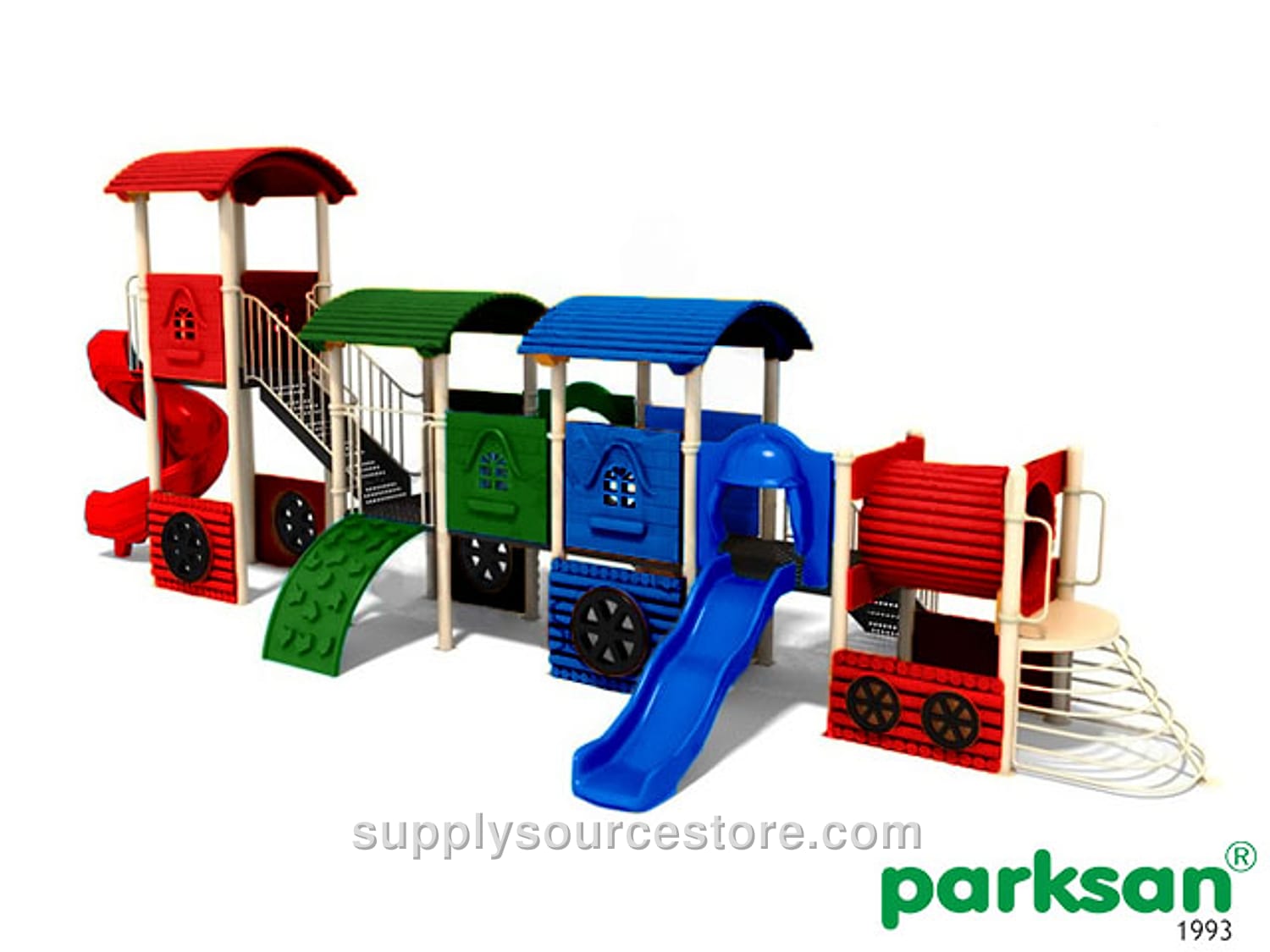
Children’s Playground (Train Series) · SS-012428
Price on request
SKU: SS-012428
Product Technical Specifications – Age Range: 3‑14 years – Capacity: 28 persons – Dimensions: 1080 × 520 cm (425 x 205 in) – Safety Area: 1380 × 820 cm (543 x 323 in) – Maximum Height: 410 cm (161 in). Product Spare Parts: - Polyethylene Playground Train Barrier – 14 pcs - Polyethylene Train Roof – 3 pcs - 100 cm (39.4 in) Metal Climbing Element – 1 pc - 100 cm (39.4 in) Polyethylene Climbing Element – 1 pc - Polyethylene Tube Passage – 1 pc - Composite Stair – 2 pcs - Metal Stair Railing – 2 pcs - 116 × 116 mm (4.6 x 4.6 in) Square Composite Platform – 5 pcs - 100 cm (39.4 in) Tower – 4 pcs - 100 cm (39.4 in) Capped Tower – 8 pcs - 200 cm (78.7 in) Capped Tower – 4 pcs - 200 cm (78.7 in) Polyethylene Spiral Slide – 1 pc - 100 cm (39.4 in) Polyethylene Wave Slide – 1 pc Polyethylene Products: Linear low‑density polyethylene (LLDPE) is a thermoplastic used in a variety of components such as slides, stairs, railings, barriers, accessories, and roofs. It is semi‑permeable, flexible, and highly durable, offering low cost and excellent resistance to outdoor conditions, moisture, and chemicals. Masterbatch pigments used for coloring must have a lightfastness rating of 6 or higher. Wall thickness should be at least 6 mm (0.2 in) for parts subject to pressure or friction and at least 4 mm (0.2 in) for non‑load‑bearing barriers and shade structures. Thickness tolerance is ±5 %. Carrier Construction: The load‑bearing frame is made of cold‑formed steel tubes with a minimum outer diameter of 114 mm (4.5 in) and a wall thickness of at least 2 mm (0.1 in), complying with TS EN 10219‑2, TS‑6476, and DIN 2394. Tubes are welded by high‑frequency welding and coated with a polyester‑based electrostatic powder finish. The coating process includes sandblasting to remove oil, dirt, and rust, followed by powder application, baking at 200–220 °C for 20 minutes, and post‑treatment cleaning and heat treatment. Electrostatic Powder Coating: All metal components are sandblasted before coating to ensure proper adhesion. Powder is applied electrostatically and cured in a furnace at 180–200 °C for 20–30 minutes. After welding, the entire assembly is painted as a single piece to protect weld joints from corrosion.