New Generation Playground Play Set · SS-012099
Price on request
SKU: SS-012099
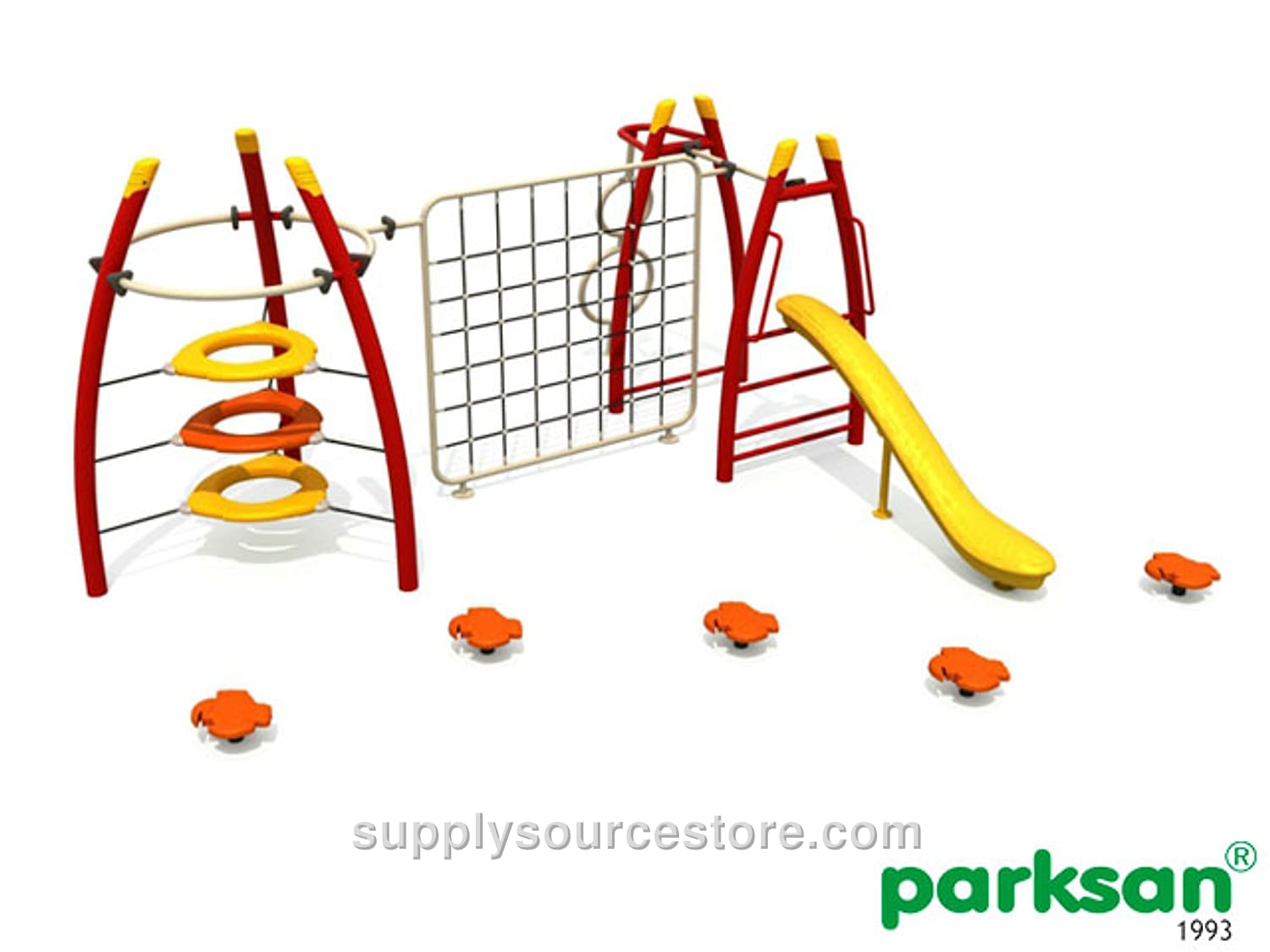
Product Technical Specifications Usage Area: 770 × 735 cm (303 x 289 in) Safety Area: 774 × 740 cm (305 x 291 in) Age Range: 3–12 years Dimensions: 580 × 520 × 270 cm (228 x 205 x 106 in) Capacity: 7–10 children Number of Slides: 1 Spare Parts - H: 245 cm (96.5 in) Simit Pass Climbing Element – 1 piece - H: 60 cm (23.6 in) Single Rolling Bearing – 5 pieces - H: 245 cm (96.5 in) Ribbed Square Net Climber – 1 piece - H: 245 cm (96.5 in) Circular Metal Climber – 1 piece Polyethylene Products Low‑density linear polyethylene (LLDPE) is a thermoplastic used in a variety of applications. It is a semi‑permeable, flexible, and highly durable polymer with low cost and high resistance, making it popular in industry. Depending on density and chemical characteristics, it is classified into several categories. Its mechanical properties depend on molecular weight, crystalline structure, and branching type. Although properties vary by type, general attributes include good resistance to outdoor conditions and moisture, flexibility, low mechanical strength, and excellent chemical resistance. Polyethylene is used to manufacture slides, ladders, guardrails, barriers, accessories, roofs, and more. To prevent color fading, masterbatch pigments used for coloring polyethylene must have a lightfastness rating of 6 or higher. The product’s wall thickness must be at least 6 mm (0.2 in) where the material is subjected to pressure and friction, and a minimum of 4 mm (0.2 in) for components that are not load‑bearing, such as barriers and shade structures. Material distribution must be uniform to achieve consistent thickness. Dimensional tolerance for product thickness and measurements is ±5%. Electrostatic Powder Coating Process All metal components are pre‑treated by sandblasting to remove oil, grease, and rust, creating a porous surface that improves paint adhesion. Fine stainless‑steel beads are then sprayed with compressed air to open micro‑pores for better coating grip. After cleaning, metal parts are coated with a polyester‑based electrostatic powder and cured in a 200–220 °C oven for 20 minutes. Subsequent to coating, parts undergo a degreasing bath at 70 °C for 10 minutes (5 % concentration), followed by a phosphating bath at 50 °C for 15 minutes (1 % concentration). Final rinsing and drying are performed, after which the entire product is coated with a weather‑resistant polyester powder and baked at 180–200 °C for 20–30 minutes. All welds are fully protected by painting the complete assembly after welding to prevent corrosion.