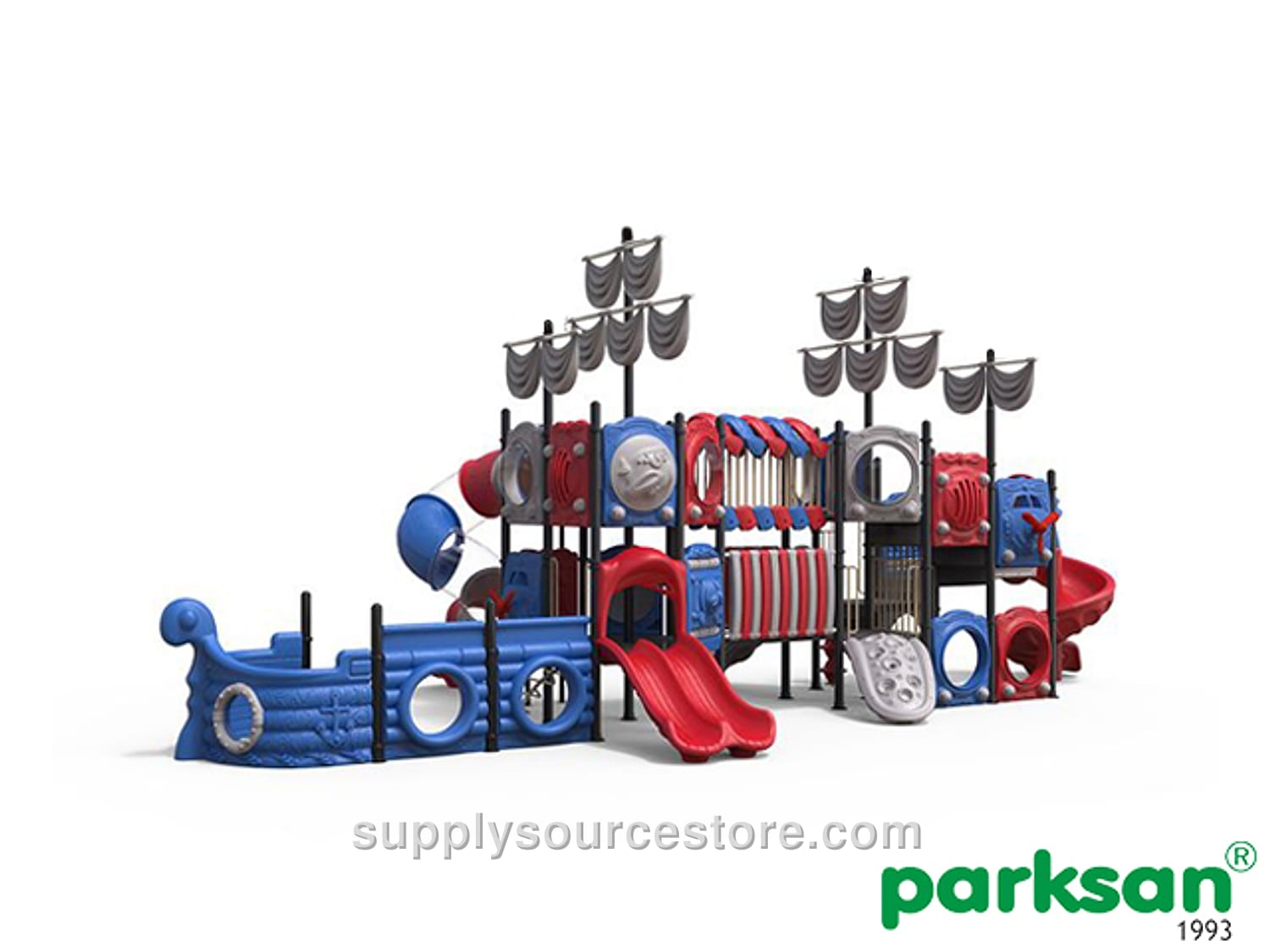
Children’s Playground (Ship Series) · SS-011821
Price on request
SKU: SS-011821
Technical specifications: Product dimensions: 1270 × 700 × 650 cm (500 x 276 x 256 in). Age range: 2–12 years. Safety area: 185 m (7283 in)². Spare parts: Polyethylene ship bow assembly – 1 piece; Polyethylene ship – 2 pieces; Metal climbing ladder – 1 piece; 116 × 116 mm (4.6 x 4.6 in) triangular composite platform – 12 pieces; 116 × 116 mm (4.6 x 4.6 in) square composite platform – 15 pieces; Polyethylene seating barrier – 18 pieces; Metal climbing entrance – 2 pieces; H 100 cm (39.4 in) UFO climbing element – 1 piece; Shaded bridge passage – 1 piece; Bridge passage – 1 piece; Polyethylene ship figure – 4 pieces; Polyethylene fuse figure – 2 pieces; H 100 cm (39.4 in) dual straight slide – 1 piece; H 150 cm (59.1 in) tube spiral slide – 1 piece; H 100 cm (39.4 in) straight slide – 1 piece; H 150 cm (59.1 in) spiral slide – 1 piece; Polyethylene climbing element – 1 piece. Polyethylene products: Low‑density linear polyethylene (LLDPE) is a thermoplastic used in a variety of applications. It is semi‑permeable, flexible and highly durable, offering low cost and high resistance, which makes it widely used in industry. Mechanical properties depend on molecular weight, crystalline structure and branching type. Typical traits include good resistance to outdoor conditions and moisture, flexibility, low mechanical strength, and excellent chemical resistance. Polyethylene is used for slides, ladders, railings, barriers, accessories, roofing, etc. To prevent color fading, masterbatch pigments used for coloring must have a light‑fastness rating of 6 or higher. Wall thickness must be at least 6 mm (0.2 in) for components exposed to pressure or friction, and at least 4 mm (0.2 in) for barriers and shade structures that are not load‑bearing. Material distribution must be uniform, and thickness tolerance is ±5%. Carrier construction: Steel tubes with a minimum outer diameter of 114 mm (4.5 in) and a minimum wall thickness of 2 mm (0.1 in), conforming to TS EN 10219‑2, TS‑6476 and DIN 2394, are cold‑formed and welded by high‑frequency welding. Tubes are sandblasted and coated with a polyester‑based electrostatic powder paint. Electrostatic powder‑paint process: All metal parts are sandblasted to remove oil, dirt and rust, creating a porous surface for better paint adhesion. Fine steel shot is applied with pressurized air to open micro‑pores. After cleaning, parts are coated with polyester‑based electrostatic powder paint and cured in a 200–220 °C oven for 20 minutes. Following paint application, parts undergo a 10‑minute dip at 70 °C in a 5 % oil‑removal bath, then a 15‑minute dip at 50 °C in a 1 % iron bath, followed by rinsing and drying. Finally, the entire assembly is painted in a single coat and baked at 180–200 °C for 20–30 minutes to ensure corrosion‑free protection.